As I reflect on the various #SMEM developments from the past week I am somewhat appalled at how much negative attention was showered upon the Larimer County Sheriff's Office (@LarimerSheriff). The criticism began after the Sheriff dared to ask the media to refrain from immediately publishing video or photos of homes damaged by the High Park Fire (#HighParkFire, #Cofire). Depending on whose account you read it seemed as if the First Amendment itself had gone up in smoke!
The Denver Post shed light on the issue when they published an article commenting on the Sheriff's request and subsequent media response. The article summed up the issue stating:
"At times the journalistic imperative to deliver news clashed with authorities' efforts to control the flow of information
On Monday, the Larimer County Sherriff's Office issued a request to the media not to show photos of destroyed homes out of respect to homeowners.
Station managers acknowledged the sensitivity of the issue, but turned aside the plea on journalistic grounds."
In the #SMEM world this relatively tame article was quickly drowned out by very loud voices which looked to condemn the Sheriff for issuing his request. Blogger Dave Statter (@STATter911 http://www.statter911.com/) wrote a flippant article which, in extreme sarcastic flare, outlined his view of the perceived government clamp down. You can read his article here:
This was followed up by an article from Emergency Management Magazine (@EmergencyMgtMag) entitled: Should Law Enforcement Determine What News Media Can Show or Not Show. The article, written by Gerald Baron, did at least consider that the Sheriff's motives were not entirely maniacal: Those ghouls are at it again: TV stations turn down Colorado Sheriff's request not to show burned or burning homes.
But that was as forgiving as it got. Baron concluded the article stating:"What is the most surprising is that the Larimer County Sheriff's office would make that request. Maybe they did it for political reasons, showing their sensitivity, while realizing that what they were asking was out of line and totally unrealistic."
"But, maybe not. I suspect that this sad story is one more example of how some authorities are simply not understanding the world in which they now live, a world that has changed dramatically over the past few years. Larimer County Sheriff: Wake up, you are living in the Internet age."
Seriously? Do we have to jump to such harsh conclusions? The Larimer Sheriff, though not perfect, is well aware of the Internet age. They have a Twitter account (@LarimerSheriff) which has been pushing out constant updates (they are even mastering the art of the hashtag!) Their counterpart, @LarimerCounty, is likewise participating in the Internet information outreach campaign via Twitter and via their website. Both entities also have corresponding Facebook accounts that are also involved in the effort.
Clearly the Larimer County Sheriff's Office is aware that we are living in an Internet age. If nothing else the following tweets illustrate this:
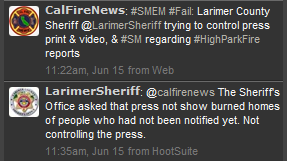
The fact that @LarimerSheriff responded to this issue via a Twitter conversation with @CalFireNews is a clear example showing that the Sheriff's Office's has a strong understanding of the Internet age.
Now let's take a close look at the Sheriff's message:
Now let's take a close look at the Sheriff's message:
Can we in the #SMEM community calm down and simply take the Sheriff's request at face value? The Sheriff by no means squashed the 1st Amendment. He simply asked the media to give him some time to deliver horrible news to affected families."The Sheriff's Office asked that press not show burned homes of people who had not been notified yet. Not controlling the press."
Is it too much to ask that everyone exercise some basic civility and responsibility even while freely exercising their First Amendment rights? Ours certainly is a brave new world where information flows freely and swiftly but that by no means must lead to a world where basic manners and rules are antiquated or defunct.
I have begun to use the phrase, "With Great Tweeting, Comes Great Responsibility". Let's face it, when we, the public, or the media press "send" our messages, pictures, and videos are immediately broadcast to the world. This is a great and powerful tool which must be taken advantage of by the all entities to include the government, media and public. Yet this same fact of immediate broadcast capability does not diminish our responsibility to ensure that the message is accurate and appropriately delivered. On the contrary, our new found power only increases our responsibility.
When I consider the Larimer County Sheriff's request I see a reasonable request that simply attempts to allow the managing agency to make important notifications before a family's pain and suffering slaps them in the face via live television or live tweet.
To close, I am must share that I am disappointed in some members of our #SMEM community. I expect more from us. I expect that we would embrace my new favorite maxim, "With Great Tweeting Comes Great Responsibility". Let's encourage everyone to go forth and exercise their First Amendment rights, but let's also ask them to do so wisely and with great care.
Just because we can inform the world by hitting "send" does not mean we always should!
